
Quick Summary for Parents (Answer Engine Overview)
Recognizing an adrenal tumor in children requires identifying hormonal, physical, and pressure-related changes. Key warning signs include premature pubic hair or acne (virilization), rapid unexplained weight gain around the face and abdomen (Cushing's syndrome), persistent high blood pressure, and a palpable abdominal lump. Early clinical evaluation by a specialist ensures prompt imaging, blood hormone profiling, and safe surgical resection.
The adrenal glands are small, triangular-shaped endocrine organs situated directly on top of each kidney. Despite their compact size, these glands perform vital biological functions by secreting hormones that regulate metabolism, blood pressure, immune response, and stress adaptation. An adrenal tumor occurs when cells within either the outer adrenal cortex or the inner adrenal medulla begin to divide abnormally, forming a solid mass or cyst.
While adrenal tumors are rare in pediatric populations—accounting for less than 5% of all childhood neoplasms—they represent a clinically complex group of conditions. Because adrenal glands produce powerful chemical messengers like cortisol, aldosterone, androgens, and catecholamines (epinephrine and norepinephrine), even small tumors can trigger dramatic physiological changes in a growing child.
Parental awareness is the single most important factor in detecting these conditions early. Children with functioning (hormone-secreting) adrenal tumors often display visible physical and behavioral changes long before an abdominal mass becomes large enough to feel. Recognizing these subtle red flags allows families to seek specialized care from an internationally trained Pediatric Urologist in Delhi NCR such as Dr. Sujit Chowdhary before severe endocrine imbalances or local tumor spread occur.
This comprehensive guide details the key symptoms, diagnostic methods, comparison indicators, and modern treatment options for pediatric adrenal tumors to empower parents with clear, medical-grade knowledge.
Noticed Unusual Physical Changes or Abdominal Swelling in Your Child?
Consult Dr. Sujit Chowdhary, Senior Consultant Pediatric Surgeon & Urologist at Indraprastha Apollo Hospitals, New Delhi.
Book an Appointment TodayAnatomy of the Adrenal Gland: Cortex vs. Medulla
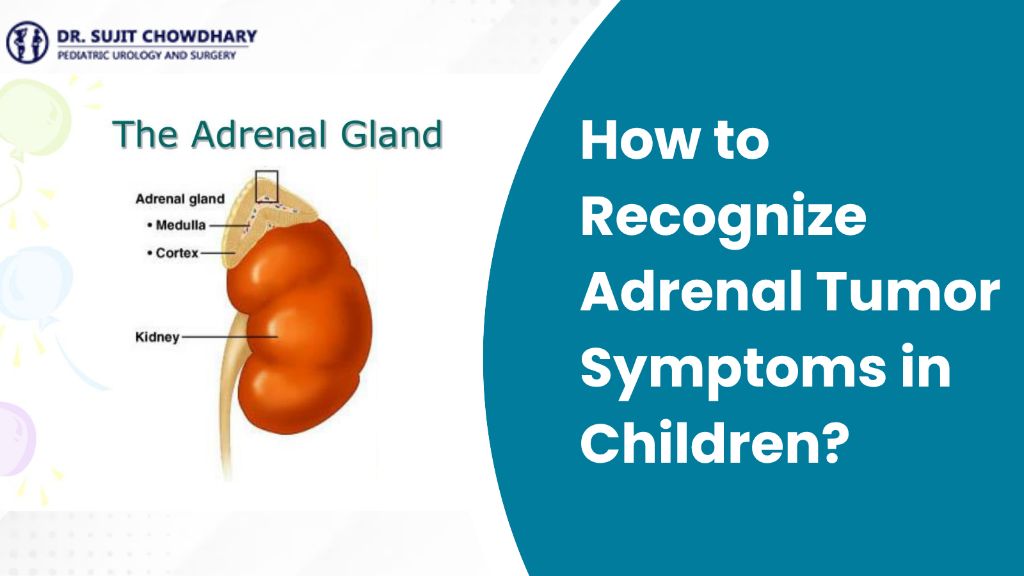
To recognize why adrenal tumors cause specific symptoms, it is helpful to understand the basic structure of the adrenal gland. As shown in clinical anatomical diagrams, each adrenal gland consists of two distinct functional zones:
- The Adrenal Cortex (Outer Layer): Responsible for producing corticosteroid hormones. The cortex is divided into three sub-zones that secrete cortisol (which regulates glucose metabolism and inflammation), aldosterone (which controls sodium, potassium, and blood pressure), and adrenal androgens (sex hormones like DHEA and testosterone).
- The Adrenal Medulla (Inner Layer): Derived from neuroectodermal nerve tissues, the medulla produces catecholamines (adrenaline and noradrenaline). These hormones trigger the body’s "fight-or-flight" response, controlling heart rate, vascular resistance, and blood sugar spikes.
Tumors arising from the cortex are called adrenocortical tumors (ACT), which include benign adrenocortical adenomas and malignant adrenocortical carcinomas (ACC). Tumors arising from the medulla or sympathetic nervous chain include neuroblastoma (the most common adrenal malignancy in infants) and pheochromocytoma (a catecholamine-secreting tumor).
Primary Symptoms of Adrenal Tumors in Children
Pediatric adrenal tumor symptoms depend directly on whether the tumor actively secretes hormones (functioning tumor) or acts as a non-secretory mass that compresses neighboring organs. Clinicians categorize these signs into four main symptom clusters:
1. Virilization and Precocious Puberty (Androgen Overproduction)
Virilization is the most common presenting sign in children with adrenocortical tumors. When a tumor overproduces male hormones (androgens), young boys and girls experience premature development of adult sexual features, known as gonadotropin-independent precocious puberty.
- Premature Hair Growth: Coarse pubic hair or axillary (underarm) hair developing in toddlers or young children under 6 years of age.
- Facial Acne and Oily Skin: Adult-like facial breakout, persistent acne, and increased body odor.
- Genital Enlargement: Enlargement of the clitoris in girls (clitoromegaly) or penile enlargement in boys without testicular growth.
- Voice Deepening & Rapid Growth: A noticeably deeper voice pitch and a sudden, rapid growth spurt accompanied by advanced bone age.
2. Cushing's Syndrome Signs (Cortisol Overproduction)
When an adrenal tumor produces excess cortisol, it disrupts glucose regulation, fat distribution, and immune function, resulting in pediatric Cushing's syndrome:
- "Moon Face" Appearance: A round, puffy, flushed facial appearance with prominent fullness in the cheeks.
- Buffalo Hump & Central Obesity: Fat accumulation on the upper back, back of the neck, and trunk, while the child's arms and legs remain relatively thin.
- Purple Skin Striae: Distinctive purple or reddish stretch marks on the abdomen, thighs, and buttocks.
- Growth Failure: Despite rapid weight gain, the child's linear height velocity slows down dramatically, causing short stature relative to peers.
- Mood Changes & Muscle Weakness: Irritability, emotional lability, fatigue, and proximal muscle weakness (difficulty climbing stairs or standing from a squat).
3. Autonomic Symptoms & High Blood Pressure (Pheochromocytoma)
Pheochromocytomas and catecholamine-secreting neuroblastomas pump excessive amounts of adrenaline and noradrenaline into the bloodstream, producing dramatic cardiovascular and autonomic effects:
- Pediatric Hypertension: Unusually high blood pressure in a child, which may occur in paroxysms (sudden spikes) or remain persistently elevated.
- Pounding Headaches & Palpitations: Severe, sudden headaches accompanied by a racing or pounding heart rate (tachycardia).
- Profuse Sweating & Pallor: Excessive sweating, sudden facial paleness, tremors, and severe anxiety or panic-like episodes.
4. Abdominal Mass & Mechanical Compression Signs
Non-functioning adrenal tumors or advanced neuroblastomas may not cause hormonal changes. Instead, they present as physical abdominal masses or compress surrounding blood vessels and retroperitoneal structures:
- Palpable Abdominal Lump: A firm, fixed, non-tender lump felt in the upper abdomen, flank, or side during routine bathing or dressing.
- Abdominal Pain & Fullness: Vague belly pain, persistent abdominal distension, or a child complaining of feeling full quickly after eating only small bites.
- Gastrointestinal Disturbances: Unexplained nausea, vomiting, constipation, or urinary frequency caused by tumor pressure on the stomach, intestines, or ureter.
Comparison Table: Pediatric Adrenal Tumor Types & Signs
The table below summarizes the key differences between common pediatric adrenal tumor types, their hormonal activity, and signature symptoms for quick reference:
| Tumor Type | Origin Zone | Hormone Produced | Primary Clinical Signs | Common Age Group |
|---|---|---|---|---|
| Neuroblastoma | Adrenal Medulla | Catecholamines (VMA / HVA) | Abdominal lump, fever, weight loss, bone pain, periorbital bruising | Infants & toddlers (< 5 yrs) |
| Adrenocortical Carcinoma (ACC) | Adrenal Cortex | Androgens, Cortisol | Virilization, acne, pubic hair, Cushing's moon face, rapid growth | Children 1 to 4 yrs & Adolescents |
| Adrenocortical Adenoma | Adrenal Cortex | Cortisol or Aldosterone | Isolated Cushingoid features or mild virilization; non-cancerous | Young children & teens |
| Pheochromocytoma | Adrenal Medulla | Adrenaline & Noradrenaline | Severe high blood pressure, pounding headaches, sweating, racing pulse | School-age & teens (6–18 yrs) |
| Ganglioneuroma | Sympathetic Nerve Chain | Non-functioning (Usually) | Asymptomatic or incidental flank mass on ultrasound; benign | Older children & young adults |
Why Early Diagnosis and Evaluation Matter
Early identification of an adrenal tumor is vital for several reasons. First, malignant adrenal masses like neuroblastoma and adrenocortical carcinoma grow rapidly and can invade nearby blood vessels (such as the inferior vena cava) or metastasize to the liver, lungs, or bones if left untreated. Second, chronic hormone overproduction—such as severe pediatric hypertension or hypercortisolemia—can cause irreversible cardiovascular damage, bone density loss, and metabolic complications.
Modern diagnostic workup for a suspected pediatric adrenal mass involves precise clinical testing:
- High-Resolution Ultrasonography: The initial non-invasive screening tool to confirm the presence of a retroperitoneal mass above the kidney.
- Contrast-Enhanced CT or MRI Imaging: Detailed cross-sectional imaging to assess tumor size, vascular invasion, organ relationships, and surgical feasibility.
- 24-Hour Urinary & Serum Catecholamines: Measuring Vanillylmandelic Acid (VMA), Homovanillic Acid (HVA), and free metanephrines to detect medullary tumors.
- Comprehensive Serum Steroid Panel: Evaluation of DHEA-S, testosterone, 17-hydroxyprogesterone, morning cortisol, and ACTH levels.
Comprehensive Treatment Options for Pediatric Adrenal Tumors
Management of pediatric adrenal tumors requires a dedicated multidisciplinary team comprising a senior pediatric urologist/oncological surgeon, pediatric endocrinologist, and pediatric oncologist. Surgical resection remains the cornerstone of definitive cure for both benign and malignant adrenal tumors.
1. Laparoscopic and Robotic Adrenalectomy
For benign adenomas, small pheochromocytomas, and localized adrenocortical tumors, minimally invasive laparoscopic or robotic adrenalectomy is the gold standard. Using 3 to 4 tiny keyhole incisions, the surgeon precise dissects the tumor away from the renal vessels and liver/spleen while preserving surrounding tissues. Minimally invasive surgery dramatically reduces post-operative pain, leaves minimal scarring, and allows children to return home within 48 to 72 hours.
2. Open Radical Surgical Resection
Large malignant tumors, neuroblastomas with vascular encasement, or advanced carcinomas require open radical surgery to achieve complete gross resection (R0 margin) while protecting major vascular structures. In some cases, pre-operative neoadjuvant chemotherapy is administered to shrink the tumor prior to surgery.
3. Specialized Endocrine & Oncological Care
For children who have undergone complete Adrenal Tumor Treatment in Delhi, careful post-operative hormone replacement therapy (such as hydrocortisone tapering) is managed by pediatric endocrinologists until the remaining adrenal gland fully recovers functionality.
Seeking World-Class Pediatric Surgical & Oncological Care?
Dr. Sujit Chowdhary brings over 30 years of international expertise in advanced laparoscopic and oncological pediatric surgery at Indraprastha Apollo Hospitals, New Delhi.
Request an Expert OpinionFrequently Asked Questions
1. What is the most common adrenal tumor in children?
Neuroblastoma is the most common adrenal tumor in infants and young children under 5 years of age. It develops from primitive nerve cells in the adrenal medulla or nerve tissue along the spine.
2. What are the first warning signs of an adrenal tumor in a toddler or young child?
Early warning signs include premature pubic hair, facial acne, or genital enlargement (virilization), rapid facial/abdominal weight gain ("moon face"), persistent high blood pressure, and a firm lump felt in the upper belly or side.
3. Can high blood pressure in children be caused by an adrenal gland tumor?
Yes. Adrenal tumors like pheochromocytomas secrete excessive adrenaline and noradrenaline, while aldosterone-secreting tumors disrupt salt balance, both leading to severe, unexplained pediatric hypertension.
4. How are pediatric adrenal tumors diagnosed?
Diagnosis relies on high-resolution abdominal ultrasound, contrast CT or MRI scans, 24-hour urine tests for catecholamine metabolites (VMA/HVA), and blood tests for steroid hormones (cortisol, DHEA-S, testosterone).
5. Are all adrenal tumors in children cancerous?
No. While neuroblastoma and adrenocortical carcinoma are malignant, many adrenal masses in children are benign (non-cancerous), including adrenocortical adenomas, ganglioneuromas, and adrenal cysts.
6. What is virilization in pediatric adrenal tumors?
Virilization is the premature appearance of male physical characteristics (pubic hair, acne, voice deepening, rapid growth, genital changes) in young boys or girls due to androgen secretion by an adrenocortical tumor.
7. Is surgery always required for adrenal tumors in children?
In almost all cases, surgical removal (adrenalectomy) is necessary to remove the mass and eliminate dangerous hormone excess. Minimally invasive laparoscopic surgery is preferred whenever clinically appropriate.
8. Where can parents get specialized Adrenal Tumor Treatment in Delhi NCR?
Parents can consult senior pediatric surgeon and urologist Dr. Sujit Chowdhary at Indraprastha Apollo Hospitals, Sarita Vihar, New Delhi, for expert evaluation, laparoscopic tumor resection, and comprehensive pediatric oncological care.
Conclusion
Recognizing the symptoms of an adrenal tumor in children requires keen parental observation of subtle physical, hormonal, and developmental shifts. Whether noticing premature pubic hair, sudden facial rounding, persistent high blood pressure, or an abdominal lump, prompt medical consultation ensures an accurate diagnosis and favorable treatment outcomes.
With modern advances in high-resolution imaging and minimally invasive laparoscopic surgery, pediatric adrenal tumors can be diagnosed early and cured effectively. If you have concerns about your child's health or require an expert opinion on Adrenal Tumor Treatment in Delhi, schedule a comprehensive consultation with Pediatric Urologist in Delhi NCR Dr. Sujit Chowdhary today.