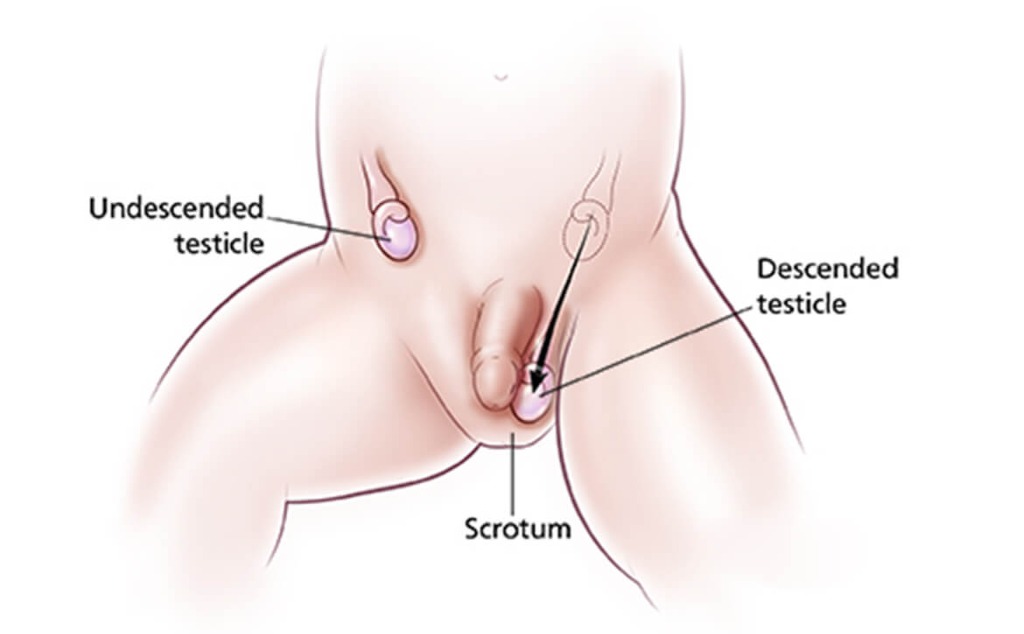
An absent testis (clinically non-palpable testis, associated with cryptorchidism) means the testicle cannot be felt in the scrotum. This might be because the testis is located high up inside the abdomen or groin (undescended testis), or because it never properly formed or shriveled before birth (vanishing/absent testis) due to a prenatal vascular event. Proper medical evaluation for absent testis treatment in Delhi by an expert pediatric urological specialist, usually involving diagnostic laparoscopy, is necessary to confirm the diagnosis.
The descent of the testicle during late pregnancy is a complex process. Key factors that can cause or contribute to a testicle remaining undescended or absent include:
Parents or pediatricians can identify a potential undescended testicle by looking for the following signs:
A minimally invasive camera check to confirm if the testis is present in the abdomen or is truly absent.
Using fine keyhole instruments to release the testis from the abdomen and place it securely into a scrotal pocket.
A staged laparoscopic procedure for high abdominal testes, securing collateral blood supply before moving the testis.
Expert pediatric urology exam under warm conditions, sometimes backed by ultrasound to check the groin area.
Laparoscopy is performed to find the testis, dissect it free from surrounding tissues, and extend the blood vessels.
The testis is pulled down and fixed inside a small pouch in the scrotum. The procedure is performed as daycare.

When considering absent testis surgery in Delhi, a non-palpable testis high in the abdomen requires expert diagnostic laparoscopy and surgical descent to preserve future fertility.
Pediatric urologists recommend performing orchidopexy (surgical descent of the testicle) between 6 to 12 months of age. Early intervention before 1 year helps preserve germ cells, supports healthy testicular growth, and protects future fertility.
When a testicle cannot be felt during physical examination, diagnostic laparoscopy is the gold standard diagnostic tool. Ultrasound and MRI scans can often be inconclusive for high abdominal testes. Keyhole laparoscopy allows direct visualization of the abdominal cavity to locate the testis or confirm if it is truly absent.
Advanced absent testis surgery in Delhi utilizes minimally invasive laparoscopic techniques. Under general anesthesia, high-definition keyhole cameras and fine instruments are used to mobilize testicular blood vessels and relocate the testicle into the scrotal sac with minimal tissue trauma.
Yes, laparoscopic orchidopexy for non-palpable or absent testes is routinely performed as a daycare surgical procedure. Most infants return home comfortably on the same day after a short post-operative observation period.
Hormone therapy (such as HCG or GnRH injections) has a very low success rate and high recurrence rate. Modern pediatric urology guidelines favor precise laparoscopic surgery over hormone injections for treating non-palpable testes.
If diagnostic laparoscopy reveals a blind-ending vessel or atrophic residual tissue (vanishing testis), the non-functional tissue is safely removed. A cosmetic testicular prosthesis can be placed in the scrotum during puberty if requested for symmetry.
Most infants recover rapidly, feeling comfortable and active within 24 to 48 hours post-op. Parents are advised to keep the child away from straddle toys (like walker bikes) and strenuous play for about 2 weeks to allow complete healing.
If one testicle is absent or undescended, the remaining normal testicle usually compensates to provide normal hormone production and fertility in adulthood. Early medical evaluation and treatment ensure optimal reproductive health outcomes.
Daycare laparoscopic orchidopexy is highly successful in bringing down abdominal or absent testes. Schedule a consultation today.
D6, Club, 2, opposite Vasant Vihar, Vasant Vihar, New Delhi, Delhi 110057
+91 98732 06761
