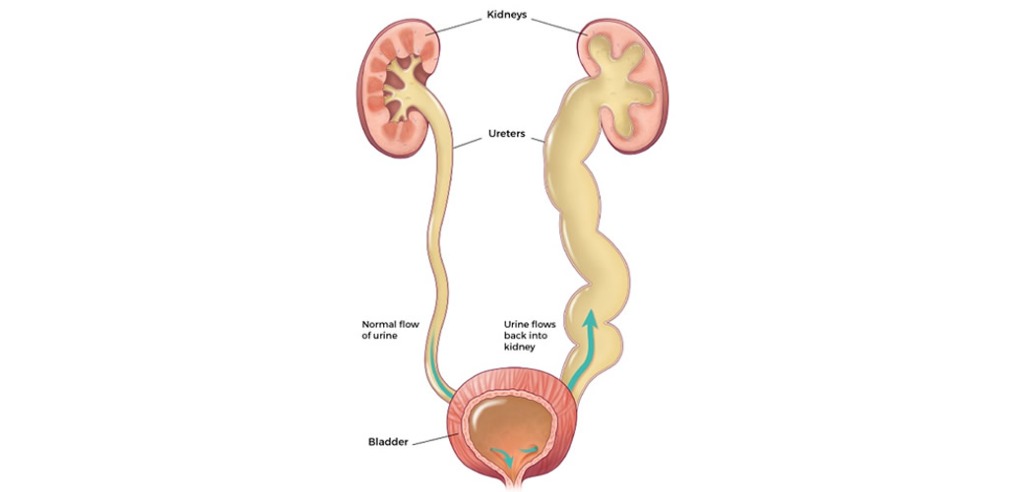
Vesicoureteric reflux (VUR) is a condition in infants and children where urine flows backward from the bladder up into the ureters and kidneys. This retrograde backflow carries infected urine from the bladder into the upper urinary tract, leading to recurrent urinary tract infections (pyelonephritis), progressive hydronephrosis, and permanent kidney scarring. Early evaluation for Vesicoureteric Reflux treatment in Delhi is vital to protect renal tissue and prevent hypertension later in life.
VUR can be classified into two primary clinical types:
Parents should watch for key clinical and imaging signs:
A minimally invasive endoscopic injection of biodegradable gel at the ureter opening to create a working valve, done as daycare.
Reconstructing the uretero-vesical junction using advanced robotic precision to create a longer, non-refluxing intramural tunnel.
A low-dose daily antibiotic regimen to keep the urine sterile and prevent kidney infections while waiting for VUR to resolve naturally.
VUR is accurately graded using a Micturating Cystourethrogram (MCU) scan, and kidney scarring is evaluated using a DMSA renal scan.
For STING, a light cystoscope is passed into the bladder to place the injection. For robotic surgery, ports are utilized to tunnel the ureters.
A follow-up ultrasound or renal scan is done in 3 to 6 months to confirm that reflux has resolved and the kidneys are draining cleanly.

When parents seek a leading Vesicoureteric Reflux surgeon in Delhi, minimal-access daycare endoscopic injection (STING/Deflux) and advanced robotic ureteral reimplantation ensure exceptional cure rates with minimal discomfort.
Vesicoureteric Reflux (VUR) is a congenital condition where the flap-valve mechanism between the ureter and bladder is incompetent, allowing urine to flow backwards toward the kidneys during bladder contraction.
VUR is diagnosed using a Micturating Cystourethrogram (MCU / VCUG) imaging scan and graded from Grade I (mild reflux into lower ureter) to Grade V (severe reflux with extreme dilation and tortuosity of ureters and kidneys).
No, lower grades (Grade I–III) often resolve spontaneously as the child grows and the ureteric tunnel lengthens. Low-grade VUR is managed conservatively with continuous low-dose prophylactic antibiotics and regular monitoring.
STING is a minimally invasive daycare procedure where a pediatric urologist inserts a miniature cystoscope into the bladder and injects a biocompatible gel (Deflux) under the ureter opening, creating a firm bulge that acts as a one-way valve to stop backflow.
Ureteral reimplantation is recommended for high-grade reflux (Grade IV–V), persistent reflux that fails endoscopic STING treatment, or when breakthrough kidney infections occur despite antibiotic prophylaxis.
Yes, repeated kidney infections (pyelonephritis) caused by untreated VUR lead to renal scarring, loss of kidney function, stunted renal growth, and an increased risk of high blood pressure in adulthood.
Following STING or reimplantation, follow-up renal ultrasounds and DMSA kidney scans are scheduled at 3 to 6 months to confirm that reflux has ceased and that kidney growth and function remain healthy.
Endoscopic STING injections and robotic reimplantation offer high cure rates for VUR. Schedule a consultation today.
D6, Club, 2, opposite Vasant Vihar, Vasant Vihar, New Delhi, Delhi 110057
+91 98732 06761
