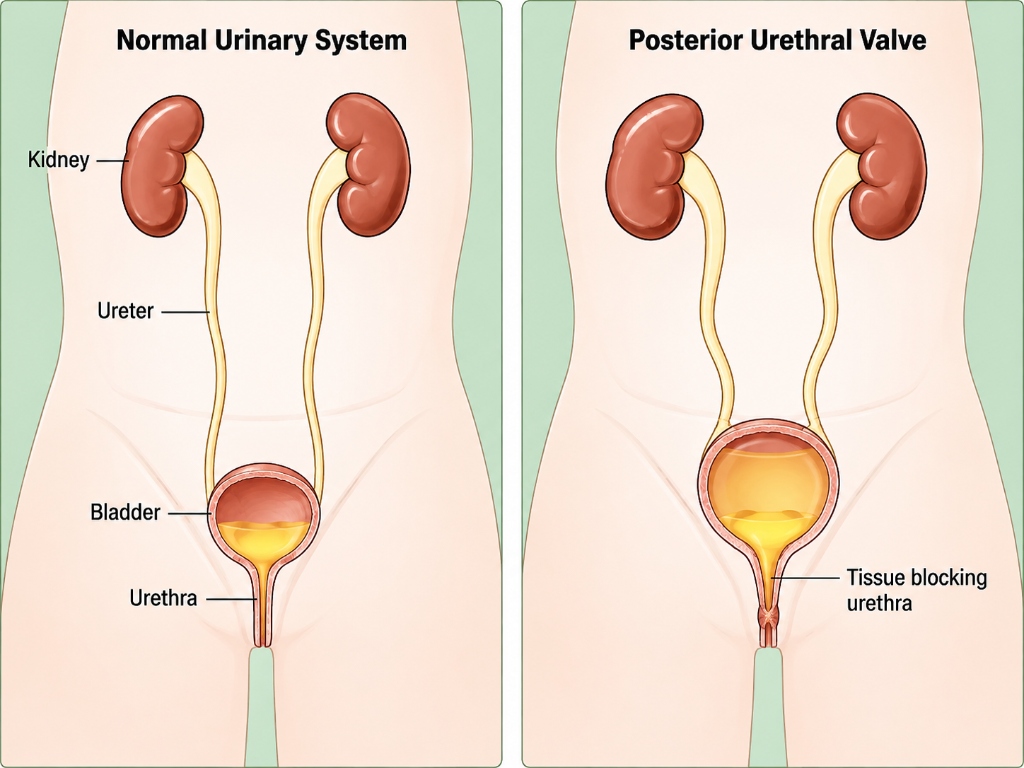
A posterior urethral valve (PUV) is a serious congenital condition occurring in newborn boys where obstructive tissue leaflets block normal urine flow from the bladder. The resulting backpressure can lead to severe bilateral hydronephrosis, bladder thickening, and secondary vesicoureteric reflux. Seeking early Posterior Urethral Valve treatment in Delhi is critical to relieve urinary obstruction and preserve kidney function in newborns.
PUV is a developmental anomaly occurring early during fetal gestation:
Symptoms range from prenatal ultrasound findings to postnatal urinary signs:
Posterior Urethral Valves (PUV) is a urological emergency in newborn boys. The severe blockage can cause rapid kidney and bladder deterioration. Immediate relief of the obstruction is vital to halt further damage and give the kidneys a chance to recover. Delayed treatment can lead to end-stage renal disease, requiring dialysis or a kidney transplant early in life.
Treating PUV is a long-term commitment. Even after the valves are successfully ablated, the child may have a "valve bladder" that functions poorly. Our comprehensive care includes regular urodynamic studies, kidney function tests, and continuous bladder management to protect the upper urinary tract and ensure optimal long-term outcomes for your child.
Primary treatment using a miniature cystoscope to cut the obstructive valves without external incisions.
A temporary surgical opening in the bladder to allow urine to drain freely in very small or sick infants.
Long-term care involving medications and catheterization to manage persistent bladder dysfunction.
Upon diagnosis, a small catheter is placed to immediately drain the bladder and allow the kidneys to start recovering before surgery.
A daycare procedure where the valves are precisely removed using a neonatal cystoscope. No external incisions are made.
Regular checkups are essential to monitor kidney growth and bladder function as the child matures into adolescence.

When parents seek an experienced Posterior Urethral Valve doctor in Delhi, comprehensive neonatal endoscopic valve ablation, advanced urodynamics, and long-term valve bladder protocols are essential to safeguard the child's long-term renal health.
Posterior Urethral Valves (PUV) are abnormal tissue folds in the posterior urethra of male infants that act as a one-way valve, obstructing urine flow out of the bladder and causing severe urinary backpressure on the kidneys.
PUV is often suspected on prenatal ultrasound showing bilateral hydronephrosis (swollen kidneys) and low amniotic fluid (oligohydramnios). Postnatally, it is confirmed via a Voiding Cystourethrogram (VCUG / MCUG) imaging study.
Initial management involves emergency bladder decompression using a soft catheter to relieve pressure and stabilize kidney function, followed by endoscopic primary valve ablation.
Endoscopic valve ablation is a daycare keyhole procedure. Using a miniature neonatal cystoscope inserted through the urethra, the surgeon precisely cuts or cauterizes the obstructive valve leaflets without any external skin incisions.
Even after successful valve ablation, many children experience persistent bladder wall thickening or hypertonia ("valve bladder syndrome"). Long-term management involves regular urodynamic studies, prophylactic antibiotics, and anticholinergic medications to protect the kidneys.
In premature or extremely small infants where endoscopic cystoscopy cannot be safely performed, a temporary vesicostomy (a small cutaneous opening in the lower abdomen draining the bladder) is created to relieve obstruction until the baby grows.
Yes, early valve ablation combined with lifelong pediatric urology monitoring protects renal function, allows normal growth, and helps boys achieve healthy urinary control and quality of life.
Endoscopic valve ablation relieves bladder obstruction and protects renal health. Schedule a consultation today.
D6, Club, 2, opposite Vasant Vihar, Vasant Vihar, New Delhi, Delhi 110057
+91 98732 06761
