
Medical Disclaimer: This article is published strictly for general educational purposes under National Medical Commission (NMC) guidelines. It does not replace individualized clinical evaluation, genetic counseling, or personalized pediatric surgical advice. Always consult a qualified specialist for assessment of your child's condition.
Direct Answer for Parents (AEO Summary)
No, in 90% to 95% of cases, Anorectal Malformation (ARM or imperforate anus) is NOT directly hereditary. Most occurrences are sporadic and multifactorial, resulting from a blend of subtle polygenic factors and early embryonic intrauterine events rather than a single inherited gene mutation. For parents of a child with isolated ARM, the recurrence risk in future pregnancies is very low—between 1% and 3%. Only 5% to 10% of cases relate to inherited genetic syndromes like Currarino or Townes-Brocks syndrome.
Welcoming a new baby is an emotional milestone. When doctors discover that a newborn has an absent or abnormally placed anal opening, parents naturally feel shocked and anxious, asking:
"Did we pass this on to our baby? Is an anorectal malformation hereditary? If we have another child, will it happen again?"
Parental guilt is common but unfounded. Embryological research confirms that lower intestinal anomalies are not caused by maternal stress, ordinary diet, or parental fault. Scientific data on anorectal malformations on Wikipedia and pediatric registries provide reassuring clarity.
In this parent guide, leading Senior Consultant Pediatric Surgeon & Pediatric Urologist Dr. Sujit Chowdhary explains imperforate anus genetics, recurrence risks for future children, syndromic causes, and surgical solutions. For families seeking advanced reconstructive care, Anorectal Malformation Treatment in Delhi offers comprehensive care from newborn evaluation to complete long-term bowel continence.
Seeking Clarity on Your Child's Anorectal Malformation?
Get evidence-based guidance and surgical counseling from Dr. Sujit Chowdhary in Delhi.
Book a Consultation with Dr. ChowdharyWhat is an Anorectal Malformation (ARM)?
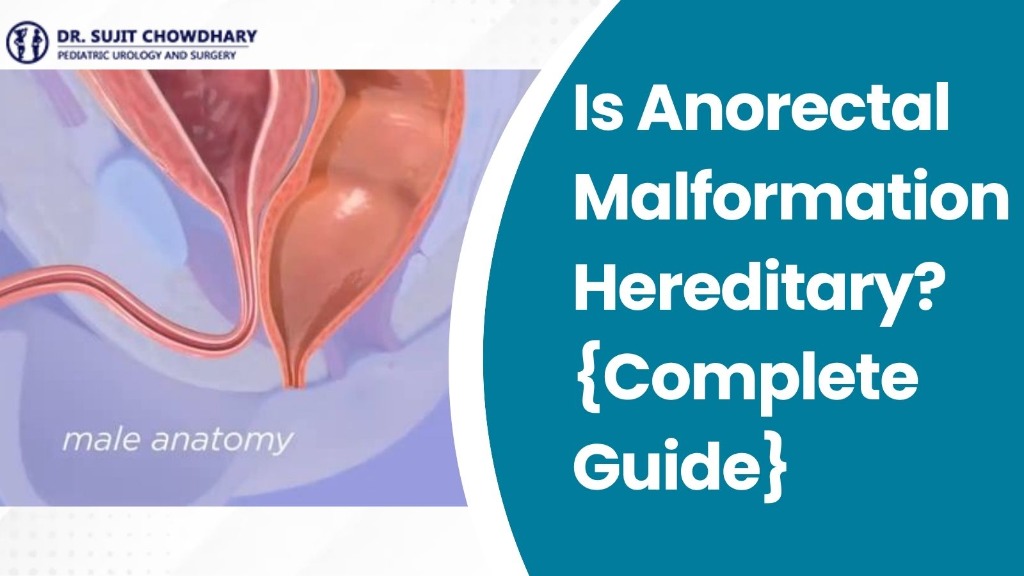
An Anorectal Malformation (ARM), historically called an imperforate anus, is a spectrum of congenital defects where the lower digestive tract does not open normally. It occurs in roughly 1 in every 4,000 to 5,000 live births worldwide, affecting boys and girls alike.
Between weeks 4 and 12 of pregnancy, the embryonic hindgut and urinary tract share a common chamber called the cloaca. A descending tissue partition (the urorectal septum) normally separates this chamber into the bladder in front and the rectum behind. If this division halts, an anorectal malformation occurs.
Anomalies range from low defects (a narrow fistula opening on the perineal skin) to high defects (where the rectum opens into the bladder, urethra, or vagina). Clues may appear before delivery through antenatal diagnosis of anorectal malformation or during newborn checks for urological problems in newborns.
Is Anorectal Malformation Hereditary? (The Scientific Answer)
The clear, reassuring fact is that over 90% to 95% of anorectal malformations are NOT hereditary. They occur sporadically in families without any previous history of anorectal differences.
Pediatric surgeons and geneticists categorize anorectal anomalies into two groups:
1. Isolated / Sporadic ARM (90% to 95% of Cases)
These occur at random under a multifactorial model of inheritance: minor polygenic traits interact with early intrauterine events during embryonic development. No single inherited parent gene is responsible.
Important Reassurance for Parents
An isolated imperforate anus is never caused by stress, minor illnesses, normal physical activity, or food consumed during pregnancy. It is an accidental developmental pause during embryonic tissue folding. Parents should never blame themselves.
2. Syndromic / Genetic ARM (5% to 10% of Cases)
In 5% to 10% of infants, ARM occurs within a recognized syndrome (e.g., MNX1 or SALL1 gene mutations) or chromosomal aneuploidy, following distinct inheritance patterns.
Sporadic vs. Syndromic ARM: Key Differences
The table below summarizes the practical differences between sporadic and genetic anorectal malformations:
| Clinical Feature | Sporadic / Isolated ARM | Syndromic / Genetic ARM |
|---|---|---|
| Frequency | 90% to 95% of all infants | 5% to 10% of all infants |
| Family History | No family history | May have affected relatives |
| Inheritance Mode | Multifactorial (polygenic + embryonic environment) | Single-gene (Autosomal Dominant / Recessive) or Chromosomal |
| Associated Anomalies | Usually limited to the anorectum | Involves spine, kidneys, ears, heart, or limbs |
| Recurrence Risk | Very Low: 1% to 3% | Higher: up to 25% or 50% |
What is the Recurrence Risk for Future Pregnancies?
Parents often ask: "If we have another baby, what is the chance that our next child will also have an imperforate anus?"
Medical data provide very clear and reassuring odds:
- General Population Risk: About 1 in 4,000 to 5,000 births (0.02%).
- Recurrence Risk for Next Child: For parents of a child with an isolated, non-syndromic ARM, the recurrence risk in future pregnancies is only 1% to 3%. This means there is a 97% to 99% probability that future children will have normal anatomy.
- Risk for Affected Individuals Having Children: An adult born with an isolated imperforate anus faces only a 1% to 3% chance of having an affected child, unless an autosomal dominant syndrome is involved.
When ARM Is Genetic: Recognized Syndromes
When an anorectal anomaly is genetic, pediatric specialists check for specific syndromes:
1. Currarino Syndrome (Currarino Triad)
Currarino syndrome is an autosomal dominant condition caused by mutations in the MNX1 gene on chromosome 7q36. It includes:
- Anorectal stenosis or low fistula.
- A crescent-shaped sacral bone defect (scimitar sacrum).
- A presacral mass (such as an anterior meningocele or teratoma).
An affected parent has a 50% chance of passing the mutation to each child. Symptoms range from childhood constipation to the complete triad.
2. Townes-Brocks Syndrome
Townes-Brocks syndrome is an autosomal dominant condition linked to SALL1 gene mutations on chromosome 16q12.1. It presents with an imperforate anus, dysplastic ears with hearing loss, triphalangeal thumbs, and renal anomalies like hydronephrosis in children.
3. Pallister-Hall Syndrome & Chromosomal Conditions
Pallister-Hall syndrome involves the GLI3 gene, featuring imperforate anus, extra digits, and hypothalamic hamartomas. Additionally, 2% to 4% of babies with Down syndrome (Trisomy 21) have an imperforate anus, as do infants with Cat Eye syndrome.
Is the VACTERL Association Hereditary?
Over 50% of infants with ARM have another congenital difference. When three or more co-occur, it is designated as VACTERL association (Vertebral, Anal, Cardiac, Tracheoesophageal, Renal, Limb).
Despite involving multiple organs, VACTERL association is non-hereditary and sporadic. It reflects an early embryonic event rather than an inherited gene defect. The recurrence risk remains under 1%.
Comprehensive Newborn Evaluation & Surgical Planning
Ensure your baby receives a full diagnostic evaluation under Dr. Sujit Chowdhary in Delhi NCR.
Explore Expert ARM Treatment in DelhiEnvironmental and Maternal Risk Factors
Because most cases are not inherited, researchers look at non-genetic maternal and environmental influences during early embryonic development:
- Maternal Diabetes: Poorly controlled pre-gestational or early gestational diabetes increases the risk of caudal developmental defects, including imperforate anus.
- Maternal Obesity: Pre-pregnancy BMI over 30 is linked to a slight increase in digestive tract malformations.
- Medication Exposures: First-trimester exposure to teratogens like sodium valproate, thalidomide, or statins can disrupt cloacal septation.
- Tobacco Smoking: Maternal smoking restricts embryonic tissue oxygenation during early organ formation.
- Assisted Reproduction (IVF): A slight statistical increase in anomalies is noted in IVF registries, thought to reflect parental subfertility or epigenetic factors.
When Is Genetic Counseling Recommended?
Genetic counseling is recommended if:
- Your baby has multiple birth anomalies (ear tags, thumb differences, spinal defects, or heart issues).
- Spinal imaging reveals a scimitar sacrum or presacral mass, suggesting Currarino syndrome.
- There is a family history of anorectal defects, sacral surgery, or unexplained chronic severe constipation.
- Parents are closely related by blood (consanguinity).
- Parents seek personalized reassurance and targeted ultrasound plans for a future pregnancy.
Modern Treatment and Long-Term Outlook
Whether an anorectal malformation is sporadic or syndromic, what matters most is timely, precise surgical reconstruction and dedicated post-operative care.
With Posterior Sagittal Anorectoplasty (PSARP) and laparoscopic reconstruction, pediatric surgeons precisely reposition the rectum inside the natural sphincter muscles:
- Low Defects: Repaired in the newborn period with a single gentle procedure (minimal PSARP or anoplasty).
- Intermediate & High Defects: Managed in planned stages: a temporary newborn colostomy to ensure safe feeding, followed by definitive PSARP at 3 to 6 months and eventual colostomy closure.
Under the care of Dr. Sujit Chowdhary offering Anorectal Malformation Treatment in Delhi, over 90% of children with low or intermediate defects achieve excellent bowel control and lead active, fulfilling lives.
Frequently Asked Questions (FAQs)
Q1. Is Anorectal Malformation (ARM) inherited directly from parents?
In over 90% to 95% of cases, Anorectal Malformation (ARM or imperforate anus) is not directly inherited from parents. The vast majority of occurrences are sporadic and multifactorial, arising from a combination of subtle polygenic factors and early embryonic intrauterine influences rather than a single inherited gene mutation.
Q2. If our first baby was born with an imperforate anus, what is the recurrence risk for our next child?
For parents with one child affected by an isolated, non-syndromic anorectal malformation, the empirical recurrence risk in future pregnancies is very low—typically estimated between 1% and 3%. While this is slightly higher than the general population risk of roughly 1 in 5,000 live births, it means there is a 97% to 99% probability that future children will not have an anorectal malformation.
Q3. Can an adult who had an imperforate anus as a baby pass it on to their children?
Most adults who were treated successfully for an isolated imperforate anus in infancy have children with normal anatomy. The risk of passing it on remains low (approximately 1% to 3%), unless their condition was part of a specific inherited autosomal dominant condition such as Currarino syndrome or Townes-Brocks syndrome.
Q4. What genetic syndromes are most commonly linked to anorectal malformations?
Approximately 5% to 10% of ARM cases link to genetic conditions, including Currarino syndrome (MNX1 gene), Townes-Brocks syndrome (SALL1 gene), Pallister-Hall syndrome (GLI3 gene), Cat Eye syndrome, and chromosomal trisomies like Down syndrome (Trisomy 21).
Q5. What is Currarino syndrome, and why is genetic testing recommended for it?
Currarino syndrome is an autosomal dominant condition characterized by a triad: anorectal stenosis, a crescent-shaped sacral defect (scimitar sacrum), and a presacral mass (meningocele or teratoma). It is caused by MNX1 gene mutations. Because each child has a 50% inheritance risk, genetic testing and family screening are recommended.
Q6. Is the VACTERL association considered hereditary?
The VACTERL association (Vertebral, Anal, Cardiac, Tracheoesophageal fistula, Renal, and Limb anomalies) is generally non-hereditary and sporadic. It has an estimated recurrence risk of less than 1% for subsequent pregnancies, though comprehensive prenatal screening and postnatal organ assessments are always standard clinical practice.
Q7. Are there prenatal genetic tests that can detect an anorectal malformation during pregnancy?
Standard prenatal genetic tests (such as NIPT, chorionic villus sampling, or amniocentesis with chromosomal microarray) do not screen specifically for isolated imperforate anus because most cases are non-chromosomal. However, if ultrasound detects fetal bowel dilation, pelvic cysts, or multiple anatomical markers, prenatal chromosomal microarray (CMA) or whole exome sequencing (WES) can rule out syndromic causes.
Q8. Where can families consult for expert genetic guidance and Anorectal Malformation Treatment in Delhi?
Families can consult Dr. Sujit Chowdhary, Senior Consultant Pediatric Surgeon & Urologist in Delhi NCR. With over 30 years of clinical leadership, Dr. Chowdhary provides advanced anomaly evaluations and surgical care for Anorectal Malformation Treatment in Delhi.
Conclusion & Next Steps for Parents
Hearing that your baby has an anorectal malformation is challenging, but parents can take comfort knowing that anorectal malformation is rarely hereditary. Over 90% to 95% of cases occur spontaneously with no prior family history, and the recurrence risk for future pregnancies is low (1% to 3%).
For the small percentage of families where a syndromic condition is identified, genetic counseling and specialized imaging provide a clear path forward. With today's advanced pediatric surgical techniques, children born with an imperforate anus grow, thrive, and enjoy active, joyful childhoods.
Schedule a Priority Surgical & Anomaly Consultation
Connect with Dr. Sujit Chowdhary in Delhi NCR for world-class pediatric colorectal reconstruction.
Contact Dr. Sujit Chowdhary's Office