
Medical Disclaimer: This article is AI-assisted and published for educational purposes under National Medical Commission (NMC) guidelines. It does not replace professional clinical consultation. Please consult a qualified pediatric surgeon for personal health concerns.
Direct Answer for Parents
Yes, Hirschsprung's disease can be effectively cured. Advanced surgical procedures called pull-through surgery permanently resolve the condition. Because the condition results from a congenital absence of ganglion nerve cells in the lower bowel, medications cannot regrow these missing nerves. However, by surgically removing the diseased aganglionic segment and connecting healthy, nerve-rich intestine down to the anus, normal bowel function is permanently restored. With modern single-stage or laparoscopic techniques, over 90% of children achieve independent bowel control and grow up living healthy, active lives.
Welcoming a new baby brings joy. When an infant does not pass their first dark stool within 24 to 48 hours, develops abdominal swelling, or vomits green bile, anxiety sets in. When doctors investigate these symptoms, one of the primary structural blockages they identify is Hirschsprung's disease.
Also termed congenital megacolon or aganglionic megacolon, this condition sounds frightening. Parents immediately wonder: Can Hirschsprung's disease be cured? Does my child need lifelong medicine or an ostomy bag, and will they ever use the toilet normally?
In this guide, Senior Consultant Pediatric Surgeon & Urologist Dr. Sujit Chowdhary explains how the bowel is affected, how pull-through surgeries cure the condition, and what recovery entails. For families seeking advanced surgical care, expert Hirschsprung Disease Treatment in Delhi offers specialized minimally invasive solutions for infants and young children.
Worried About Infant Constipation or Vomiting?
Early evaluation by a dedicated pediatric colorectal specialist ensures timely diagnosis and optimal surgical outcomes.
Book an Expert ConsultationWhat Happens in the Body with Hirschsprung's Disease?
In a healthy digestive tract, the bowel wall contains a network of tiny nerve units called ganglion cells. These cells coordinate muscular contractions, known as peristalsis, moving stool smoothly toward the exit.
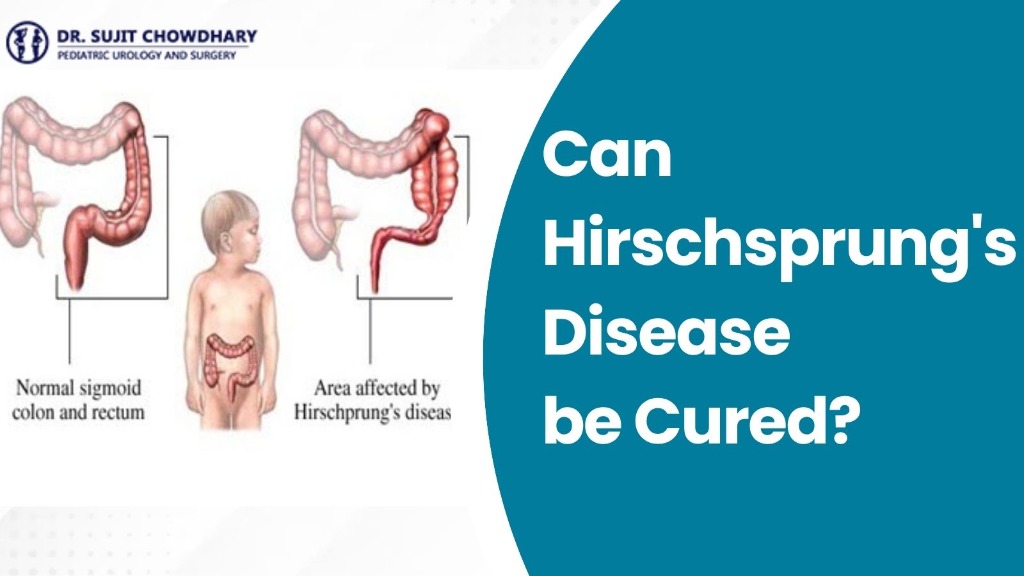
During early fetal development, these nerve cells travel down the intestine. In babies with Hirschsprung's disease, this journey halts prematurely. Consequently, the final stretch of the large intestine—usually the rectum and part of the sigmoid colon—lacks nerve cells entirely. This area is called the aganglionic segment.
Without ganglion cells, muscles in that segment cannot relax and remain tightly shut. Stool and gas cannot pass through this tight zone. Normal bowel above the blockage tries hard to push stool forward, causing that healthy section to stretch and swell into an enlarged colon.
Key Information for Families
Hirschsprung's disease occurs in roughly 1 out of every 5,000 live births and is about four times more common in boys. In about 80% of children, the affected area is short-segment disease, involving only the rectum and sigmoid colon.
Can Hirschsprung's Disease Be Cured Permanently?
Yes, Hirschsprung's disease is permanently curable. It is a localized absence of nerve cells rather than a chronic inflammatory disease.
Because the body cannot grow new nerve cells after birth, medicines and laxatives cannot clear the physical blockage. Instead, curative pediatric surgery resolves the problem completely. The surgeon removes the non-functioning bowel and pulls healthy intestine with normal nerve cells down to the anus. Once healed, the reconstructed bowel moves stool naturally, and the condition does not return in healthy tissue.
Recognizing Early Signs: When to Suspect Hirschsprung's Disease
Early diagnosis prevents complications like bowel inflammation. Parents and pediatricians should watch for key early warning signs:
- Delayed Meconium Passage: Over 90% of healthy newborns pass meconium within 24 hours. A delay beyond 24 to 48 hours is the strongest initial indicator.
- Swollen Belly: Trapped gas and stool cause the infant's abdomen to swell noticeably, appearing firm and tight.
- Green Vomiting: Backed-up digestive fluids cause the baby to vomit yellowish-green fluid containing bile.
- Relief with Stimulation: A gentle rectal examination often causes trapped liquid stool and air to expel forcefully.
- Severe Constipation in Older Infants: In children with very short affected segments, symptoms may look like chronic constipation, poor weight gain, or painful stooling when starting solid food.
Much like evaluating other infant conditions such as anorectal malformation in newborns or identifying biliary atresia in infants, noticing these signs early makes treatment smoother and safer.
How Do Doctors Confirm the Diagnosis?
Before planning surgery, pediatric specialists confirm the diagnosis using three primary diagnostic tools:
- Contrast Enema X-Ray: Liquid contrast introduced through the rectum outlines the transition zone where narrow aganglionic bowel widens into dilated healthy colon.
- Rectal Suction Biopsy: The gold standard test. A tiny instrument collects a superficial pinch of rectal lining through the anus without general anesthesia, confirming the absence of ganglion cells under microscopy.
- Anorectal Manometry: A small balloon catheter tests whether the internal anal sphincter relaxes under pressure, a reflex missing in Hirschsprung's disease.
Need a Trusted Second Opinion for Your Child?
Have your baby's biopsy or X-ray reports reviewed by renowned pediatric surgeon Dr. Sujit Chowdhary in Delhi NCR.
Learn More About TreatmentHow Surgery Cures Hirschsprung's Disease: The Pull-Through
The definitive cure is called a pull-through operation. During this procedure, the pediatric surgeon removes the non-working section of the bowel and brings healthy intestine with normal ganglion cells down to connect with the anus, carefully preserving the anal sphincter muscles so the child can achieve normal bowel control.
Surgeons choose from several established techniques depending on the child's age and how much bowel is involved:
- Transanal Endorectal Pull-Through (TEPT): Performed directly through the anus without abdominal incisions. The diseased rectal lining is dissected, healthy colon is brought down, and an internal connection is made with zero visible scars.
- Laparoscopic-Assisted Pull-Through: For higher transition zones, keyhole ports (3 to 5 mm) allow camera visualization to inspect nerves and gently release the colon down to the anus.
- Classical Methods (Soave & Duhamel): The Soave procedure pulls healthy bowel through a preserved muscular sleeve, while the Duhamel procedure creates a wide retrorectal pouch that protects pelvic nerves.
Single-Stage vs. Staged Repair: Is an Ostomy Bag Required?
Many parents worry their baby will need a temporary colostomy bag. Fortunately, today most stable babies with short-segment disease undergo a single-stage repair without needing any bag. Doctors decompress the bowel with gentle daily saline washouts until surgery day.
A temporary ostomy is usually needed only in specific situations, such as severe enterocolitis, delayed diagnosis, or total colonic aganglionosis. In those cases, a temporary stoma allows the baby to feed and gain weight before completing the final pull-through.
Comparison of Surgical Pull-Through Approaches
| Surgical Method | Approach | Best Suited For | Main Advantages |
|---|---|---|---|
| Transanal (TEPT) | Through the anus; no cuts | Short-segment rectosigmoid disease | Zero scars, minimal pain, fast discharge |
| Laparoscopic-Assisted | Keyhole ports (3-5 mm) | Transition zone higher in colon | Direct visualization, fast recovery |
| Duhamel Procedure | Retrorectal pull-through | Re-operations, high transition zones | Protects anal canal, prevents strictures |
| Soave Procedure | Endorectal muscular cuff | Standard & intermediate disease | Protects pelvic nerves governing urinary function |
| Staged Repair | Temporary colostomy first | Severe enterocolitis, late presentation | Relieves obstruction, allows baby to stabilize |
What Is Life Like After Surgery? Understanding Recovery
While surgery physically cures Hirschsprung's disease, recovery requires patience as the pulled-through colon learns its new job.
Initial Weeks (Weeks 1 to 6): Stools are initially frequent (6 to 10 times daily) because the pulled-through colon has not yet adapted to absorbing water. Generous barrier cream and prompt diaper changes protect the skin until bowel movements consolidate.
Months 2 to 12: Stool consistency thickens and settles into 2 to 4 soft movements daily. Regular check-ups monitor healthy weight gain and healing.
Potty Training Milestones: Over 90% of children with standard Hirschsprung's disease gain normal bowel control by ages 3 to 4. Some children experience brief constipation during toilet training, which is easily managed with high-fiber food and structured toilet routines.
Just as in caring for children recovering from pediatric hernia in children or congenital urinary conditions like urological problems in newborns, consistent parental encouragement and regular surgical follow-ups ensure the smoothest transition to full continence.
Understanding and Preventing Enterocolitis (HAEC)
Even after successful surgery, parents must understand Hirschsprung-associated enterocolitis (HAEC). This is an inflammatory bacterial infection of the bowel that can happen if stool sits stagnant in the colon.
Signs of Enterocolitis (Contact Your Doctor Promptly)
- Sudden fever accompanied by unusual sleepiness or irritability.
- Sudden explosive, watery, foul-smelling diarrhea.
- A swollen, visibly bloated, or tender tummy.
- Poor feeding and reduced wet diapers.
If these symptoms arise, prompt medical care with intravenous hydration, antibiotics, and gentle rectal washouts resolves the infection quickly and safely.
Why Specialist Surgical Expertise Matters
Newborn pelvic anatomy is extraordinarily delicate. Performing a pull-through surgery requires delicate precision to protect the tiny nerves that govern urinary control and future reproductive health, while placing the new connection at the exact correct level above the anal sphincter.
Consulting an experienced specialist like Dr. Sujit Chowdhary ensures that your child benefits from decades of surgical experience, advanced minimally invasive technology, and dedicated long-term post-operative bowel management protocols.
Consult Senior Pediatric Surgeon Dr. Sujit Chowdhary
Ensure your child receives world-class pediatric colorectal surgical care with compassionate, individualized treatment plans in Delhi NCR.
Schedule an Appointment TodayFrequently Asked Questions (FAQs)
Q1. Can Hirschsprung's disease be cured without surgery?
No, Hirschsprung's disease cannot be cured using medications, laxatives, or diet alone. The condition is caused by a congenital absence of ganglion nerve cells in the bowel wall. Surgery is the only curative method because the non-functioning segment must be removed to allow normal peristalsis.
Q2. What is the primary surgery used to cure Hirschsprung's disease?
The definitive curative operation is a pull-through procedure. Common modern variations include Transanal Endorectal Pull-Through (TEPT), laparoscopic-assisted pull-through, and Duhamel or Soave procedures. The surgeon removes the nerve-free segment and joins healthy colon to the anal canal.
Q3. At what age is pull-through surgery usually performed?
In full-term infants diagnosed promptly and managed with saline irrigations, surgery is usually performed in the newborn period or within the first 1 to 3 months of life. If complications like enterocolitis arise, a temporary stoma is placed first with repair scheduled later.
Q4. Does every child with Hirschsprung's disease need a colostomy bag?
No. Thanks to modern techniques, most infants with short-segment Hirschsprung's disease undergo a single-stage pull-through without needing an ostomy bag. Temporary stomas are reserved primarily for cases with severe enterocolitis, extreme bowel dilation, or total colonic involvement.
Q5. Can Hirschsprung's disease recur after surgery?
Hirschsprung's disease does not recur once the abnormal segment is removed. However, temporary issues like sphincter tightness, mild constipation, or loose stools can occur during early years. These are easily managed with dietary adjustments and routine follow-up.
Q6. What is Hirschsprung-associated enterocolitis (HAEC) and how is it prevented?
HAEC is a bacterial infection of the intestine caused by stagnant stool. Symptoms include sudden fever, explosive diarrhea, and abdominal swelling. Parents help prevent HAEC by observing bowel habits, attending follow-ups, and seeking urgent care if fever and bloating occur.
Q7. Will my child be able to achieve normal potty training and bowel control?
Yes. Over 90% of children treated for classic Hirschsprung's disease achieve full, independent bowel control. With patience and dietary fiber, children attend school, play sports, and live active lives.
Q8. Where can parents find specialized Hirschsprung Disease Treatment in Delhi?
Parents seeking expert care can consult Dr. Sujit Chowdhary, Senior Consultant Pediatric Surgeon & Urologist in Delhi NCR. With over 30 years of experience in pediatric reconstructive surgery, Dr. Chowdhary provides comprehensive Hirschsprung Disease Treatment in Delhi.
Conclusion
Receiving a diagnosis of Hirschsprung's disease can feel overwhelming, but modern pediatric surgery offers a reliable and permanent cure. Through advanced minimally invasive pull-through surgeries, surgeons remove the non-working section of the bowel and re-establish a natural digestive pathway.
With early diagnosis, meticulous surgical skill, and ongoing support, children with Hirschsprung's disease overcome early digestive challenges, master toilet training, and grow into happy, thriving children. If your newborn is struggling with delayed meconium, abdominal swelling, or unusual constipation, consult a specialized pediatric surgeon for early evaluation and clear guidance.