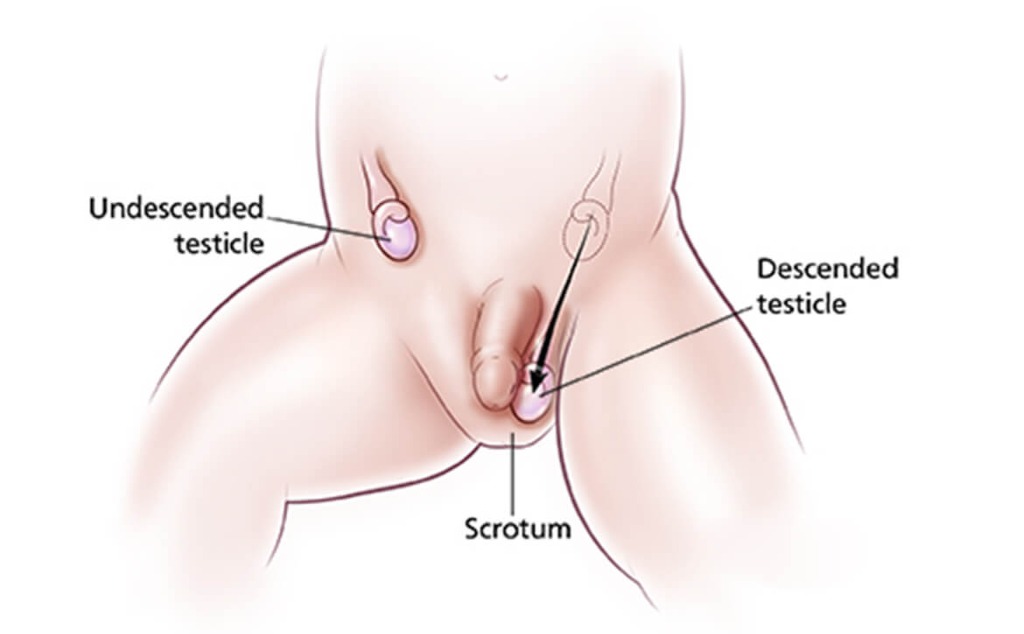
An absent testis (clinically non-palpable testis) means the testicle cannot be felt in the scrotum. This might be because the testis is located high up inside the abdomen or groin (undescended), or because it never properly formed or shriveled up before birth (vanishing/absent testis) due to a prenatal vascular event. Proper medical evaluation, usually involving diagnostic laparoscopy, is necessary to confirm the diagnosis.
The descent of the testicle during late pregnancy is a complex process. Key factors that can cause or contribute to a testicle remaining undescended or absent include:
Parents or pediatricians can identify a potential undescended testicle by looking for the following signs:
A minimally invasive camera check to confirm if the testis is present in the abdomen or is truly absent.
Using fine keyhole instruments to release the testis from the abdomen and place it securely into a scrotal pocket.
A staged laparoscopic procedure for high abdominal testes, securing collateral blood supply before moving the testis.
Expert pediatric urology exam under warm conditions, sometimes backed by ultrasound to check the groin area.
Laparoscopy is performed to find the testis, dissect it free from surrounding tissues, and extend the blood vessels.
The testis is pulled down and fixed inside a small pouch in the scrotum. The procedure is performed as daycare.
"We were worried about our son's surgery, but Dr. Chowdhary made everything so easy. The daycare procedure was smooth, and he was playing by evening!"
"Our son had an abdominal testis. Dr. Sujit's laparoscopic skill brought it down safely in a two-stage procedure. Excellent results and tiny scars."
"The best decision for our child's health. Dr. Chowdhary is incredibly patient and explained everything so well. Highly recommended."
"The precision in Dr. Chowdhary's surgery is incredible. His confidence gave us immense peace of mind during a very stressful time."
"We traveled from another city just for Dr. Chowdhary. His approach is very scientific and methodical yet very caring."
"The nursing staff and Dr. Sujit are a fantastic team. They handled our infant's surgery with so much care and warmth."
"The best decision we made for our child's health. Dr. Chowdhary is incredibly patient and explained everything so well."

A non-palpable testis high in the abdomen requires diagnostic laparoscopy and surgical descent to preserve future fertility.
Surgery (orchidopexy) is recommended between 6 months and 1 year of age to preserve germ cells and future fertility.
Diagnostic laparoscopy is the gold standard, as ultrasound and MRI cannot confirm with certainty whether a testis is absent.
Hormone therapy (like HCG) has a very low success rate and is no longer recommended in modern pediatric urology.
Yes, laparoscopic orchidopexy is routinely performed as a daycare procedure, and the child can go home the same day.
If diagnostic laparoscopy reveals a blind-ending vessel or atrophic tissue, the non-functional tissue is removed, and a cosmetic prosthesis can be placed later during puberty.
Most infants recover quickly and are active the same day. Vigorous play and stridulent toys (like straddling bicycles) should be avoided for 2 weeks.
With timely surgical descent of the other testis, fertility rates are generally normal or near-normal. Prompt surgery minimizes the risk.
Daycare laparoscopic orchidopexy is highly successful in bringing down abdominal or absent testes. Schedule a consultation today.
D6, Club, 2, opposite Vasant Vihar, Vasant Vihar, New Delhi, Delhi 110057
+91 98732 06761
