
Medical Disclaimer: This article is published for educational purposes under National Medical Commission (NMC) guidelines. It does not replace individualized clinical evaluation. Consult a pediatric specialist regarding your infant's medical care.
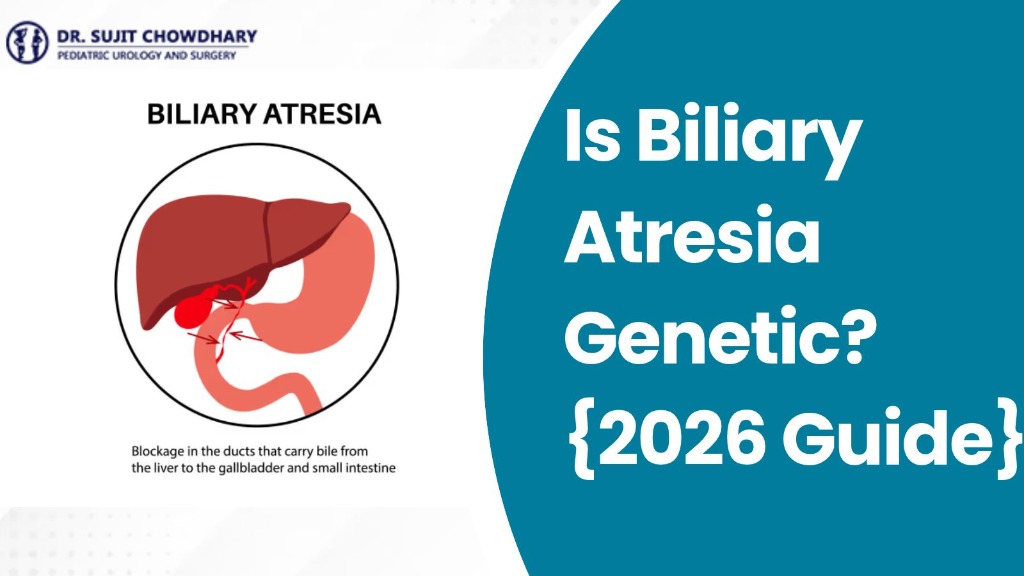
Direct Answer for Parents (AEO Quick Summary)
No, in 85% to 90% of infants, biliary atresia is NOT directly genetic or inherited from parents. It is predominantly a sporadic, acquired condition that develops around the time of birth rather than through an inherited faulty gene. For parents with an affected child, the recurrence risk in future pregnancies is very low—under 1%. Only 10% to 15% of cases involve an early embryonic form known as biliary atresia splenic malformation syndrome.
Table of Contents
- What Is Biliary Atresia?
- Is Biliary Atresia Genetic?
- Susceptibility Genes & Triggers
- Syndromic Biliary Atresia (BASM)
- Isolated vs. Syndromic Forms
- Recurrence Risk for Future Babies
- Can Treated Adults Pass It On?
- Prenatal Detection Possibilities
- Cardinal Warning Signs to Watch
- Kasai Procedure & Critical Timing
- Frequently Asked Questions
- Summary & Guidance for Families
Bringing a newborn home is an experience filled with excitement. However, when an infant stays persistently jaundiced past two to three weeks of life, and diapers show unusually pale, clay-colored stools, parents are thrust into unexpected anxiety.
A frequent question asked by families is: "Did we pass this on to our baby? Is biliary atresia genetic, and will it happen again if we have another child?"
It is important to state clearly: parental self-blame is completely unfounded. Medical data, including documented clinical research on biliary atresia on Wikipedia, confirms that the condition is not caused by what a mother ate, medication during pregnancy, stress, or parental actions.
In this guide, Senior Consultant Pediatric Surgeon & Pediatric Urologist Dr. Sujit Chowdhary explains whether is biliary atresia genetic, what science says about recurrence risks, syndromic links, and modern reconstructive solutions. Families seeking leading surgical care can explore specialized Biliary Atresia Treatment in Delhi for comprehensive infant liver care.
Concerned About Infant Jaundice or Pale Stools?
Prompt evaluation by an experienced pediatric surgeon during the first 60 days of life is critical for protecting your baby's liver.
Book an Immediate ConsultationWhat Is Biliary Atresia? Understanding the Bile Duct Blockage
The liver produces bile, a vital digestive fluid that carries waste products like bilirubin and helps digest dietary fats. In healthy newborns, bile flows from inside the liver through microscopic channels into the main extrahepatic bile ducts, which empty directly into the small intestine.
In infants with biliary atresia, these critical drainage ducts outside the liver become inflamed, scarred, and blocked. Because bile cannot drain, it accumulates inside the liver, causing toxic damage and progressive scarring (fibrosis). Without prompt surgery, this backup leads to irreversible cirrhosis.
Many parents first discover this condition while researching biliary atresia in infants when standard phototherapy fails to clear prolonged newborn jaundice. Unlike dilations such as a choledochal cyst in children, biliary atresia involves progressive fibro-obliteration of the drainage pathway.
Is Biliary Atresia Genetic or Acquired? The Scientific Facts
When considering is biliary atresia genetic, medical science separates strictly inherited single-gene conditions from complex, acquired disorders. In over 85% to 90% of affected babies, biliary atresia is an acquired, non-inherited condition termed the perinatal or isolated form.
Unlike classic inherited diseases such as cystic fibrosis, isolated biliary atresia does not follow standard Mendelian inheritance. It is neither autosomal dominant nor autosomal recessive. Key clinical facts support this reality:
- No Family History: Thousands of hospital records worldwide show that biliary atresia occurs almost exclusively in children with no prior family history of liver disease.
- Identical Twin Discordance: In documented cases of identical twins sharing 100% of their DNA, usually only one twin develops biliary atresia, while the other remains completely healthy. If the disease were purely genetic, both identical twins would develop it.
- Normal Early Duct Formation: Biopsies indicate that fetal bile ducts develop normally, only to be destroyed by an inflammatory attack around the time of birth.
Crucial Reassurance for Parents
You did not pass down a defective gene that caused this condition. Biliary atresia is primarily an acquired inflammatory event occurring around delivery. Parents should let go of self-blame.
Biliary Atresia Genetics: Susceptibility Genes and Environmental Triggers
If the condition is not directly inherited, what role does genetics play? In modern hepatology, research into biliary atresia genetics focuses on susceptibility rather than direct causation. Certain infants may inherit subtle genetic variations that make their bile duct lining more sensitive to inflammation when exposed to an external trigger.
This is understood through the "Two-Hit Model":
- First Hit (Genetic Predisposition): The infant carries minor variations in genes controlling immune regulation, ductal cell structure, or cilia function.
- Second Hit (Perinatal Trigger): An environmental factor, such as a mild viral infection (rotavirus, reovirus, or cytomegalovirus) or a temporary vascular disruption, sets off inflammation that the infant's immune system fails to turn off.
Genome-wide association studies (GWAS) have identified several susceptibility markers, including ADD3 (Adducin 3), GPC1 (Glypican 1), and EFEMP1. Carrying these susceptibility markers does not mean an infant will develop the disease; millions of healthy people carry identical genetic variations with no liver issues.
Syndromic Biliary Atresia: When a Genetic Syndrome Is Involved
In roughly 10% to 15% of infants, the blockage occurs alongside other structural birth anomalies. This form is known as embryonic or syndromic biliary atresia, where a true biliary atresia genetic syndrome affects early organ patterning during the first trimester.
The best known syndromic type is Biliary Atresia Splenic Malformation (BASM) syndrome. In this variant, embryonic lateralization (left-right organ placement) is disrupted between weeks 4 and 8 of pregnancy, leading to:
- Splenic Anomalies: Multiple small spleens (polysplenia) or an absent spleen (asplenia).
- Situs Inversus: Complete or partial mirror-image reversal of abdominal and chest organs.
- Vascular Variations: An absent inferior vena cava (interrupted IVC) or a preduodenal portal vein.
- Cardiac Defects: Septal defects or complex heart anomalies requiring pediatric cardiology review.
- Intestinal Malrotation: Incomplete bowel fixation, which surgeons assess during abdominal reconstruction.
Scientists have linked rare syndromic cases to alterations in ciliary and lateralization genes, such as CFC1 and FOXA2. Similar to other hereditary congenital anomalies, syndromic presentations benefit from comprehensive multidisciplinary surgical and genetic evaluation.
Isolated vs. Syndromic Biliary Atresia: Key Differences
Understanding whether an infant has the common isolated type or the rarer syndromic type helps guide surgical planning and long-term surveillance:
| Clinical Feature | Isolated / Perinatal Form | Syndromic (BASM) Form |
|---|---|---|
| Frequency | 85% to 90% of cases | 10% to 15% of cases |
| Timing of Onset | Perinatal / early weeks of life | First trimester (weeks 4 to 8 of pregnancy) |
| Inheritance Mode | Sporadic and multifactorial | Early developmental field defect / ciliary links |
| Associated Anomalies | None (confined to bile ducts) | Polysplenia, heart defects, situs inversus, malrotation |
| Sibling Recurrence Risk | Under 1% (<0.1%) | Low (approx. 1% to 2%) |
| Surgical Reconstruction | Standard Kasai Portoenterostomy | Kasai Procedure adapted to vascular/intestinal anatomy |
Recurrence Risk: What Are the Odds for Future Children and Siblings?
Parents who have lived through the emotional stress of biliary atresia often worry about what future pregnancies hold. A major question is whether a subsequent brother or sister faces a high risk of developing the same condition.
Reassuring epidemiological data provides clear clarity:
- General Population Risk: Occurs in approximately 1 in 10,000 to 18,000 live births in Western countries, and about 1 in 5,000 to 9,000 births in Asian populations.
- Sibling Recurrence Risk: For parents of a child with isolated biliary atresia, the empirical recurrence risk in future pregnancies is less than 1% (typically estimated between 1 in 1,000 and 1 in 5,000). There is a greater than 99% probability that future siblings will have completely healthy bile ducts.
- Consanguinity: In families where parents share close blood relations, pediatric genetic testing helps rule out rare metabolic cholestasis conditions (such as PFIC or Alagille syndrome) that can mimic biliary atresia.
Can an Adult Who Had Biliary Atresia Pass It to Their Children?
Thanks to advances in pediatric hepatobiliary surgery, thousands of children treated with the Kasai procedure or liver transplantation have grown into healthy adults. Many are now raising families of their own.
Clinical studies show that adult survivors of isolated biliary atresia do not pass the condition to their children. Their offspring have normal bile duct anatomy with no increased risk compared to the general public.
Can Prenatal or Genetic Testing Detect Biliary Atresia?
Parents frequently wonder if standard pregnancy scans or blood tests can identify biliary atresia ahead of delivery:
- Routine Prenatal Genetic Screening: Non-invasive prenatal testing (NIPT) and amniocentesis test for common chromosomal abnormalities like Down syndrome. Because isolated biliary atresia is non-chromosomal and not driven by a single inherited gene mutation, standard prenatal genetic testing cannot detect it.
- Fetal Ultrasound & MRI: During pregnancy, extrahepatic bile ducts are microscopic channels under 1 mm wide, making them invisible on routine scans. Additionally, maternal circulation clears bilirubin, so the fetus does not show jaundice in utero. However, two ultrasound clues may occasionally emerge: a consistently non-visualized gallbladder on Level II scans or a subhepatic cyst.
Recognizing these findings allows neonatologists to coordinate evaluations alongside standard checks for other newborn conditions, such as urological problems in newborns.
Early Surgery Offers the Best Opportunity to Save Native Liver
Timely surgical reconstruction within the first 60 days of life significantly improves long-term bile drainage.
Explore Biliary Atresia Treatment in DelhiCardinal Warning Signs Parents Must Watch For
Because genetic tests cannot forecast biliary atresia, early symptom recognition by parents and pediatricians is crucial:
Early Warning Symptoms of Biliary Atresia
- Prolonged Jaundice (Past 14 Days): Normal newborn jaundice usually fades within two weeks. Jaundice lasting past 14 days demands a fractionated bilirubin blood test.
- Pale, Acholic Stools: Normal infant stools are golden yellow, green, or brown. When bile cannot reach the intestines, stools turn pale cream, light yellow, or chalky white.
- Dark Urine: Excess conjugated bilirubin filtered by the kidneys produces dark amber or tea-colored urine that stains diapers.
- Firm, Enlarged Liver: Trapped bile causes liver swelling (hepatomegaly) under the right rib cage.
- Poor Weight Gain: Lack of intestinal bile impairs fat digestion and fat-soluble vitamin absorption (vitamins A, D, E, K).
Modern Treatment: Kasai Portoenterostomy & The 60-Day Window
Biliary atresia cannot be cleared by medications, special diets, or light therapy. The gold-standard surgical treatment is the Kasai Portoenterostomy, developed by Dr. Morio Kasai.
In this delicate operation, the pediatric surgeon removes the blocked fibrous bile ducts down to the porta hepatis on the liver surface. A section of the baby's small intestine is then brought up in a Roux-en-Y loop and connected directly to the liver bed, allowing microscopic bile ductules to drain directly into the intestine.
Timing determines surgical success:
- Surgery before 60 days: Achieves effective bile drainage and jaundice clearance in up to 70% to 80% of babies, preserving native liver function.
- Surgery between 60 and 90 days: Success rates drop as liver scarring progresses.
- Surgery past 90 days: Significant cirrhosis may already have formed, lowering the chances of restoring native bile flow.
If bile drainage is incomplete or liver scarring advances, pediatric liver transplantation provides an effective secondary treatment, with overall long-term survival exceeding 90%.
When to Consult Dr. Sujit Chowdhary in Delhi NCR
Timely evaluation by an experienced pediatric surgical team is vital. Families benefit from the expertise of Dr. Sujit Chowdhary, Senior Consultant Pediatric Surgeon & Pediatric Urologist with over 30 years of premier international and Indian clinical practice.
Trained in leading institutions in the UK, Australia, and India, Dr. Chowdhary offers rapid fractionated bilirubin evaluation, specialized liver ultrasonography, intraoperative cholangiography, and precision micro-surgical Kasai reconstruction. His clinic provides dedicated Biliary Atresia Treatment in Delhi, supporting families with comprehensive long-term care and nutritional monitoring.
Frequently Asked Questions (FAQs)
Q1. Is biliary atresia genetic or inherited directly from parents?
In 85% to 90% of infants, biliary atresia is not directly inherited. Most cases are sporadic and develop without family history due to a complex multifactorial process involving subtle genetic predispositions triggered by perinatal inflammatory or viral factors.
Q2. If our first baby had biliary atresia, what is the recurrence risk for our next child?
For parents with one child affected by isolated biliary atresia, the recurrence risk in future pregnancies is exceptionally low—less than 1%. There is a greater than 99% probability that future children will have normal bile duct anatomy.
Q3. What is biliary atresia genetic syndrome (BASM)?
Biliary atresia splenic malformation (BASM) syndrome is an embryonic subtype occurring in 10% to 15% of infants. It combines bile duct obstruction with other congenital anomalies such as multiple spleens (polysplenia), situs inversus, cardiac anomalies, and a preduodenal portal vein.
Q4. Can an adult who had biliary atresia pass it on to their children?
Adults successfully treated for isolated biliary atresia in infancy face a very low risk (under 1%) of passing the condition to their children. Long-term studies show that offspring of survivors generally have completely healthy livers.
Q5. Can biliary atresia be detected during pregnancy through genetic testing or ultrasound?
Routine prenatal genetic tests cannot detect isolated biliary atresia because it is non-chromosomal. Ultrasound rarely spots it directly because fetal bile ducts are microscopic, though an absent gallbladder or subhepatic cyst may prompt postnatal checks.
Q6. What genes have scientists linked to biliary atresia susceptibility?
Genome-wide studies highlight susceptibility genes including ADD3, GPC1, EFEMP1, and cilia-related genes like CFC1. These variants do not cause disease alone; they simply make bile duct cells more susceptible to inflammation or environmental triggers.
Q7. What are the earliest warning signs of biliary atresia?
The key signs include newborn jaundice persisting beyond 14 days of life, pale clay-colored stools, dark amber or tea-colored urine that stains diapers, and elevated direct (conjugated) bilirubin levels on blood testing.
Q8. Where can families receive comprehensive Biliary Atresia Treatment in Delhi?
Families can consult Dr. Sujit Chowdhary, Senior Consultant Pediatric Surgeon in Delhi NCR, for early diagnosis, precision Kasai portoenterostomy, and dedicated post-operative care for Biliary Atresia Treatment in Delhi.
Summary & Guidance for Families
Receiving a biliary atresia diagnosis is emotional and challenging. However, parents can find comfort in knowing that biliary atresia is rarely hereditary. In the vast majority of cases, it happens by biological chance rather than parental genetics or preventable factors.
With sibling recurrence risks below 1%, parents can look forward to future family planning with confidence. For their baby today, timely diagnosis and prompt surgery within the first 60 days offer the best opportunity to establish bile drainage and preserve native liver health.
Schedule a Priority Pediatric Surgical Consultation
Connect with Dr. Sujit Chowdhary in Delhi NCR for compassionate, expert evaluation and surgical care.
Contact Dr. Chowdhary's Clinic